
Eco-construction & Sustainable building

Sustainable buildings designed for the future

The building sector is at the heart of numerous shifts: energy, carbon, ecological, digital, social and societal. As an investor, developer and manager, Covivio operates throughout the real estate life cycle in order to offer ever greener, more efficient buildings capable of meeting the climate challenge.

A global and sustainable vision of the building

Analyse

Build or renovate

Monitor

Optimize

Promote

What is eco – construction?

Eco-construction is a responsible building practice that seeks to reduce the adverse impact of construction on the environment. Eco-construction aims to incorporate materials that respect the planet, maximise energy efficiency and reduce CO2 emissions. It provides a direct response to the climate emergency by creating healthy and sustainable living spaces and promoting a balance between the environment, the economy and social well-being.

An ambitious strategy for combatin climate change

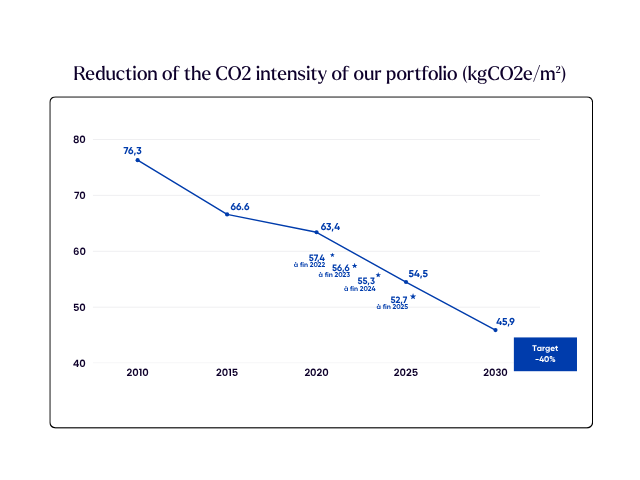
Carbon trajectory: Covivio 
commits to a – 40% reduction

In 2017/2018, Covivio verified the compatibility of its European 2030 carbon trajectory with that of the Paris Agreement of December 2015.
Produced with the CSTB (French Scientific and Technical Centre for Building) and underpinned by a strong scientific foundation, this trajectory covers Covivio’s various products in Europe (offices, hotels and residential) and was validated by the SBT (Science-Based Targets) initiative in 2018.

In 2021 and ahead of its targets, Covivio stepped up its carbon ambitions to align with a 1.5°C trajectory and aim for a “Net Zero Carbon” contribution (Scopes 1 and 2) and a well-below 2°C trajectory (Scope 3 including construction/renovation).

These objectives lead to a target reduction of -40% between 2010 and 2030 in intensity per m² owned by Covivio in Europe.

Levers to achieve our objectives

Focus on renovation and fight against urban sprawl

  • More than 50% of our new operations are regeneration projects
  • Willingness to move towards net zero artificialization to preserve areas of biodiversity
  • Circular economy, sustainable materials and installation of high-performance equipment

Commit to low-carbon construction on a European scale

  • Drafting of LCA Europe specifications (Life Cycle Analysis) to standardize calculation methods
  • BBCA label or equivalent on at least 75% of new developments in France and 50% in Germany and Italy
  • Reliable measurement of the carbon footprint of operations

Acquire new tools

  • 2 tools developed in 2020 with CSTB to accompany the implementation of the carbon trajectory:
    • Construction/renovation part: to estimate the sensitivities to the impacts of the choice of materials and construction techniques on the carbon footprint of an operation.
    • Operation part: to calculate financial and carbon impact of the energy efficiency actions carried out on the portfolio

Promote the use of renewable energies

  • Installation of equipment on development projects
  • By 2030, 100% renewable electricity supply for our directly managed assets (80% at end 2023)
  • Make our tenants aware of this possibility for private areas

Mobilize all our stakeholders to make the climate transition a success

  • Responsible Purchase policy rolled out from 2011 and use of the EcoVadis platform since 2022
  • Strong partnership strategy with tenants (sustainable development committees, green annexes, etc.)
  • Governance bodies involved: creation of a CSR Committee in 2021

Circular economy: building while conserving resources

The circular economy is one of the pillars of Covivio’s Nature Strategy, alongside biodiversity and low-carbon development. Reducing the consumption of primary resources also means reducing the impact of construction on natural ecosystems.

Our targets for 2030:

  • 30% recycled steel, 30% recycled aluminium and 30% low-carbon concrete in refurbishment projects
  • Monitoring the consumption of materials with the greatest impact (concrete, glass, steel, aluminium) across at least 80% of new projects by the end of 2026
  • An 80% recovery rate for the total volume of construction waste, including 50% through material recovery

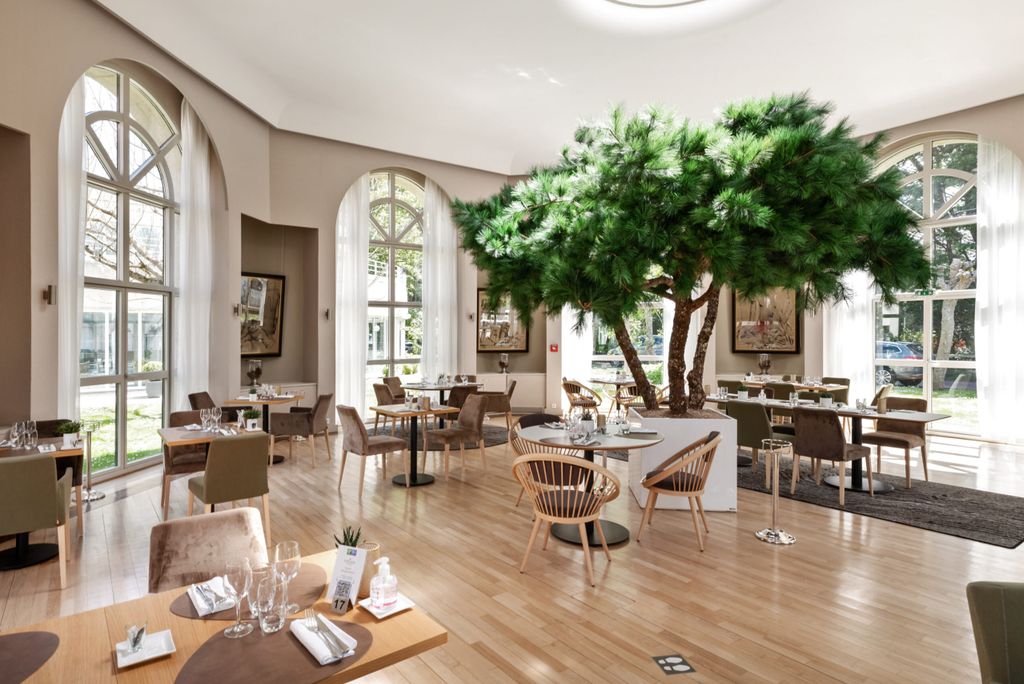
Example: At the Holiday Inn in Le Touquet, more than 2,500 items (38 tonnes) were reused thanks to a partnership with Smartback.

Environmental certification

To ensure high standards of energy efficiency, carbon footprint, well-being, connectivity and biodiversity, Covivio relies on recognised labels and certifications, which are incorporated from the project development phase right through to their operation.

These labels serve as performance benchmarks that enable the Group to objectively assess and measure its commitments across its entire portfolio.

For details of the labels and certifications deployed by theme, see the Standards and Certifications page – Covivio

Discover

nature report

At the end of 2024, Covivio published its 1st Nature Report.
This report combines climate and biodiversity, and marks a new stage in Covivio’s CSR strategy.

find
out more

CSR commitments

Covivio's CSR policy, fuelled by a concrete innovation approach and covering all its activities and countries with the same ambition, aims to be transparent and measurable in order to generate a positive impact in the short, medium and long term.
Building smart buildings

Designed to be as flexible as they are scalable, the buildings designed by Covivio provide their occupants with optimum connectivity and a tailor-made range of services, for a seamless digital experience.

The European green taxonomy

The European Green Taxonomy is a system for classifying economic activities that have a favourable impact on the environment. Its objective: to direct investment towards “green” activities.