

Covivio Newsletter
Understanding tomorrow's city
- Find out all the Covivio news every month
- Discover our latest projects: offices, residential, hotels
- Decipher the city and its challenges with our Expert Views
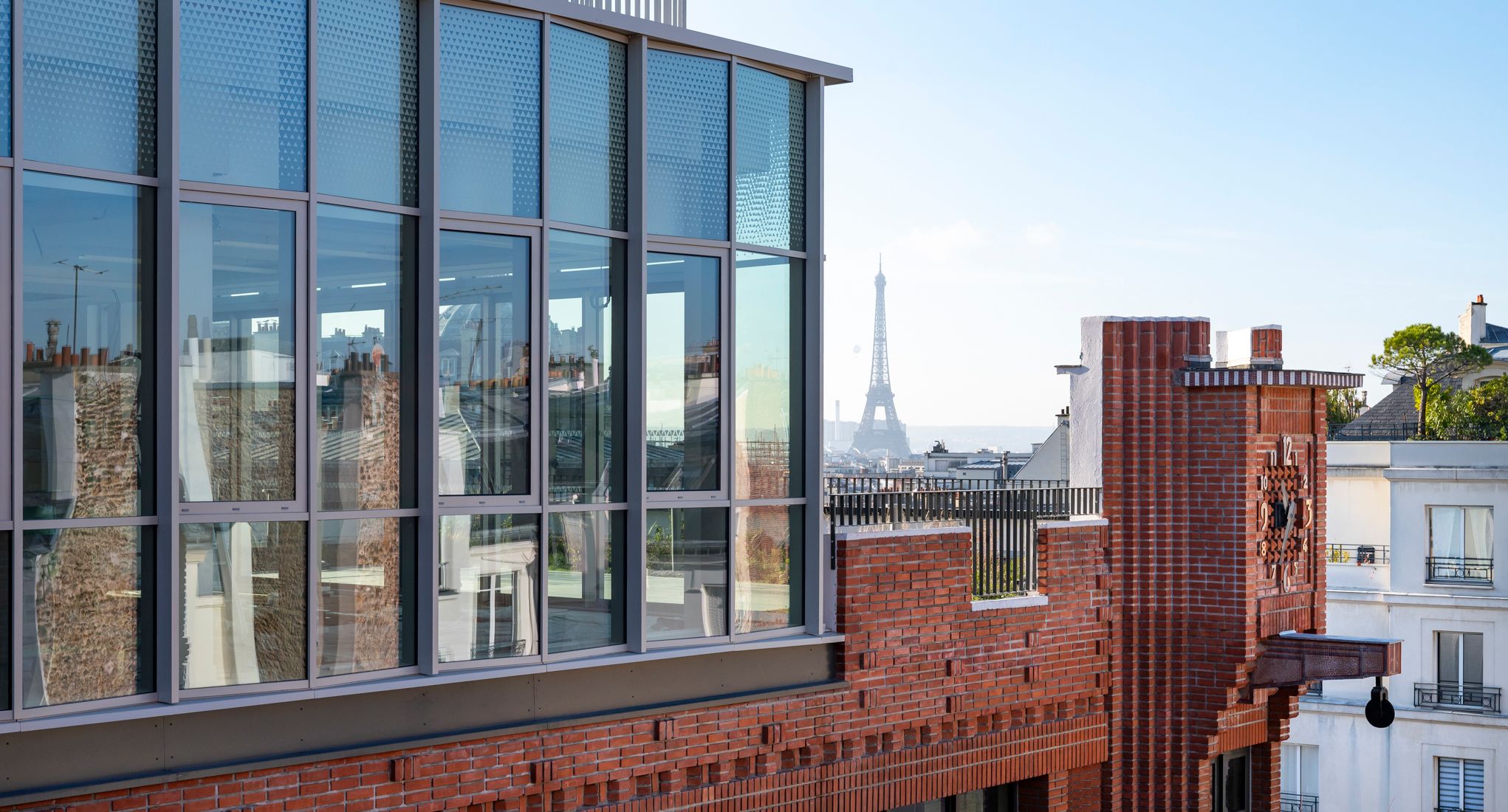



Long a symbol of single-use urban planning dedicated to the tertiary sector, Europe’s leading business district is reinventing itself and undergoing a metamorphosis to offer new ways of using the space. Will Paris La Défense become a neighborhood where people live?
Known for its Grande Arche, Paris La Défense is now Europe’s most attractive business district, according to the 2025 Global Business District Attractiveness Barometer conducted by EY and the Urban Land Institute (ULI). Ranked 4th globally, it outranks the City of London, among others. The secret to this success? The district forms a true ecosystem, home to 2,800 companies, offering numerous services, and providing excellent connectivity to Paris.
This dynamism is the result of major investments. Paris La Défense is completing a series of €400 million in investments in the district’s public spaces. Starting in 2028, a vast five-hectare garden will be created on the esplanade (which itself will be renovated between 2021 and 2023). As for transportation, 5 billion euros are earmarked between 2016 and 2031, including the extension of existing lines and the construction of several new stations.
The neighborhood’s evolution will undoubtedly not stop there. La Défense 2050, a forward-looking study produced by a group of local investors, recommends converting 275,000 m² of office space into new uses (hotels, higher education, leisure, housing, and local shops, etc.), establishing a student campus, and developing the banks of the Seine.
And if we zoom in from the neighborhood to the skyscrapers themselves, what do we see? Long considered assets that could only be monetized by leasing standardized office space to companies, they, too, are adapting to new uses without, however, denying their history.
Take, for example, the CB21 tower, designed by the New York-based firm Harrison & Abramovitz and inaugurated in 1974. Covivio acquired it in 2007 and, in 2026, partnered with architect Nicolas Sisto (Sisto Studio) to propose a new base level of services. The goal: to pay homage to the building’s vintage aesthetic while revitalizing it to meet today’s needs.
The renovation plan includes several new spaces that will complement the existing offerings. Starting in 2028, the panoramic view from the top floors will be fully showcased through a rooftop terrace and a bistronomic restaurant, both designed to be open to the public.
Changes in the world of work—particularly the rise of home office —along with economic and geopolitical uncertainties, might have led some to predict that office towers would become relics of a bygone era. Despite a generally declining market (demand for office space in the first half of 2026 was 5% lower than in 2025 in the Île-de-France region), Paris La Défense stands out as an exception, with a 52% surge over the same period.
73% of the companies that set up operations in La Défense in 2025 were not previously based in the area. Alongside the “long-standing” players in banking, healthcare, and energy, there are new entrants from a variety of sectors, including small and medium-sized enterprises (SMEs). This broad appeal is confirmed by the occupancy rate of the CB21 tower: since 2025, 25,000 m² have been leased to companies of various sizes and from diverse sectors (manufacturing, healthcare, energy, agri-food, tech, etc.).
Finally, companies are no longer the only ones using the towers, which are opening up to the wider community. CB21, for example, is home to the “DesCodeuses” collective, which has 700 m² of space to provide digital training to women from working-class neighborhoods. Work remains at the heart of Paris La Défense’s DNA: without companies, there is no business district. But this work no longer follows a single model and embraces innovative approaches, reflected in the architectural choices and urban planning of the area that hosts them.