
Covivio Newsletter
Understanding tomorrow's city
- Find out all the Covivio news every month
- Discover our latest projects: offices, residential, hotels
- Decipher the city and its challenges with our Expert Views



Experts

Materials, furniture, textures, micro-architectures: these are all details that shape the city of tomorrow and highlight aesthetic, ecological, and social choices. With the series “Chronicles of Urban Detail,” we invite you to explore emerging trends in urban design across Europe. By examining specific details and their impact on the lives of city dwellers, we reveal the transformations taking place in the urban fabric.
As the first impression of a building, the facade lies at the intersection of numerous challenges: heritage conservation and renewal, interaction with public space, technological efficiency and environmental impact. A fundamental issue for an operator such as Covivio.
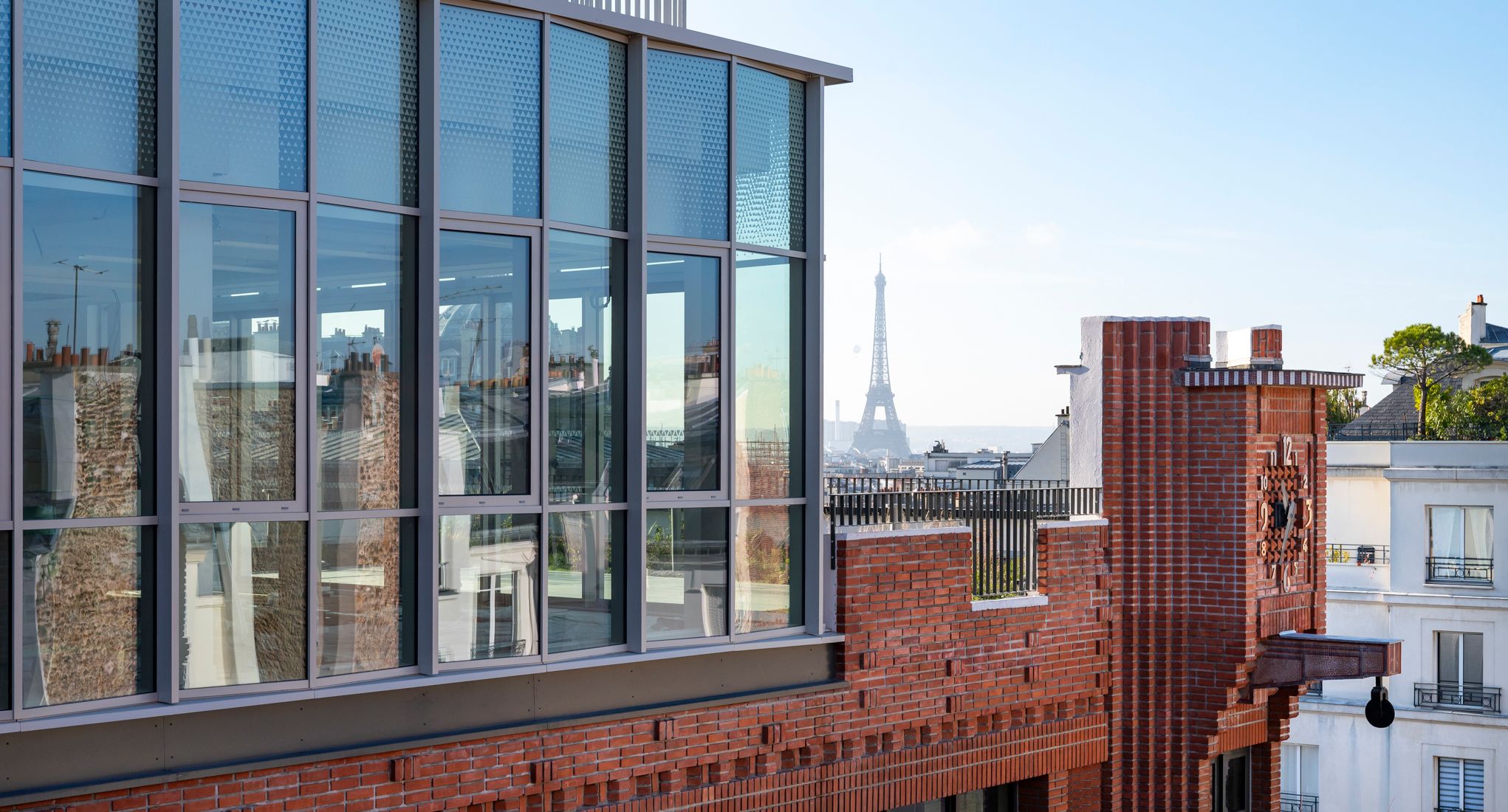
L’Atelier, Covivio’s European headquarters located in the Saint-Lazare district of Paris, combines two buildings from the 1920s and 1930s, which had already served several purposes—from a Jesuit college to a telephone exchange—with renovations in between. The architects at STUDIOS Architecture chose to restore the original façades to their full clarity by replacing the 1970s concrete additions with a glass curtain wall on the Rue d’Édimbourg façade. On the Rue de Madrid side, they also designed a new window grid, inspired by the building’s original design.
The façade can also inspire the building’s interior design, and even go a step further. The “Beige Paris” building, in the 17th arrondissement, is emblematic of 1920s architecture, with its mosaic façade – which has been echoed on the floors and lift landings in a design by Maison Sarah Lavoine. But that’s not all: Belgian designer Dries Van Noten even drew on the unique features of the building’s façade to design his menswear collection for Fashion Week 2024!
The façade symbolically marks the distinction between the public space of the street and the private space of the building… but it can also allow for permeability between the two, particularly when the ground floor houses shops or services. The ground-floor façades of the Maslö building in Levallois-Perret, for example, are glazed to create an invitation to reveal the building’s interior. The façade also plays a central role in user comfort, requiring a balance to be struck between natural light and thermal performance. A testing ground for companies in the sector, whose commitment to R&D Vincent Floquet commends. Enabling mobile phone signals to pass through high-thermal-performance glazing, or doing away with blinds thanks to electronically dimmable glazing… These are all innovations which, although not yet widely adopted, are set to develop significantly in the coming years.
The façade is a building’s identity, the way we recognise it. It is a timeless subject, one that architects and all stakeholders working on a project engage with. At Covivio, we are fortunate to develop buildings with a strong identity that stand out, starting with the façade: we aim to renovate them, to enhance them, not to change them.
VINCENT FLOQUET
Deputy Technical Director at Covivio

Developers of commercial buildings (offices, retail premises, etc.) are subject to the Tertiary Eco-Energy Scheme (DEET), also known as the ‘Tertiary Decree’, which aims to achieve a 60% reduction in final energy consumption in these buildings by 2050.
This initiative raises a number of considerations, particularly regarding the façade. As the primary interface between the interior and exterior, the façade plays a key role in controlling energy consumption and contributes directly to improving the building’s overall efficiency.
Covivio is collaborating, amongst others, with the French Institute for Building Performance (IFPEB) and its “low-carbon specifiers” hub to study the carbon footprint of façades. “The weight of the façade is not insignificant in a building’s carbon footprint. We can therefore contribute to a building’s decarbonisation by focusing our efforts on the façade,” explains Vincent Floquet.
An example of concrete action: glazing accounts for around 30% of a façade’s carbon footprint. During the renovation of Beige Paris, the old glazing was collected, amounting to a total of 12.5 tonnes of glass waste (cullet). The building’s new “Low Carbon” glazing is made from 57% cullet, resulting in a carbon footprint 40% lower than that of standard glazing.
Similarly, on The Line project in Paris’s 8th arrondissement, the entire façade has been designed with a circular approach in mind, incorporating aluminium profiles made from 100% recycled aluminium and low-carbon glazing. For the 030BLN tower at Alexanderplatz in Berlin, currently under construction, solar panels will be integrated both into the roof and directly into the façade, making it one of the first high-rise buildings in Germany to use this type of building-integrated photovoltaics.
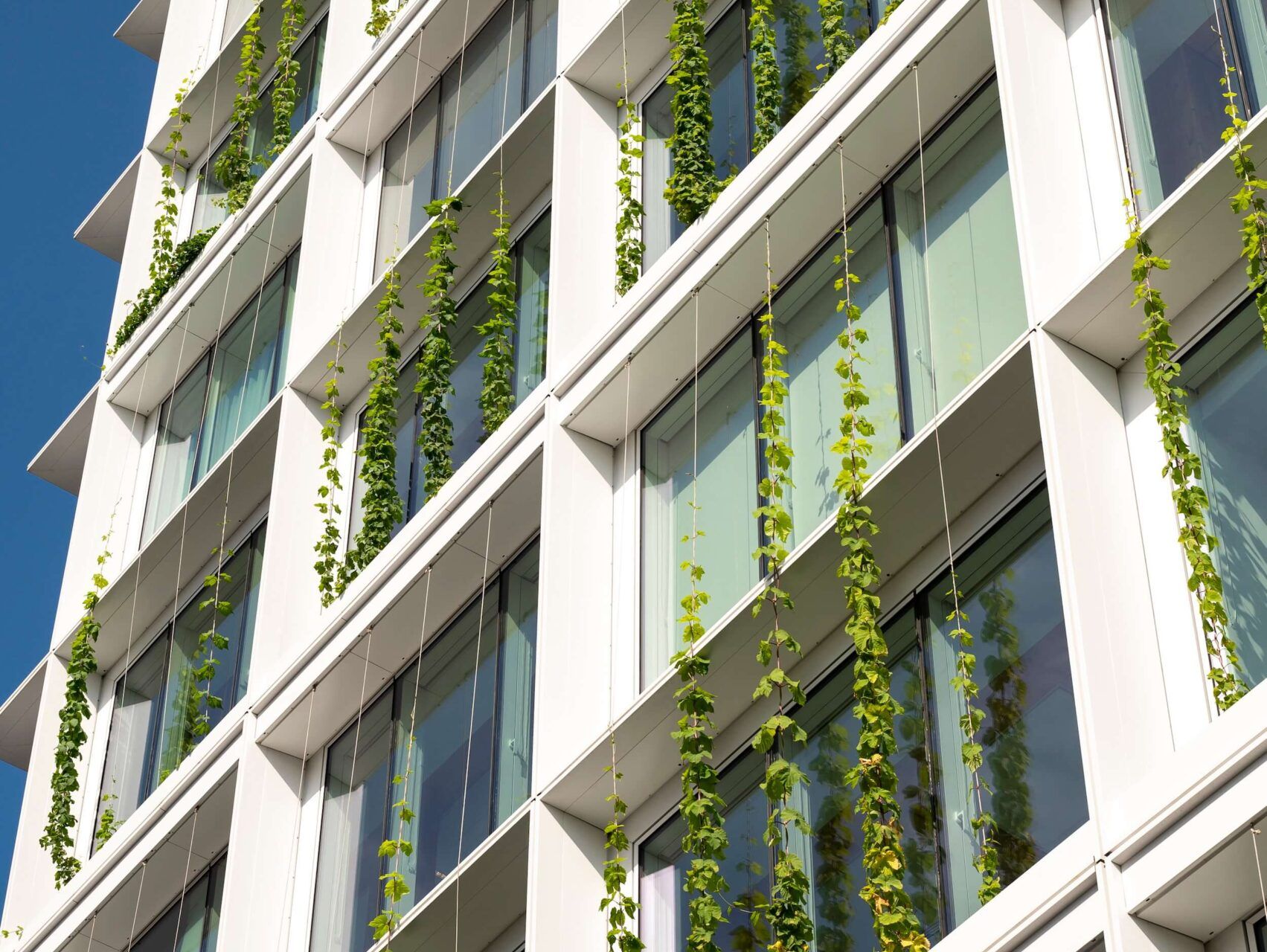
A final Covivio project to illustrate the multiple roles of façades is Stream Building in Paris’s 17th arrondissement, which blends uses, spaces and services, as well as materials. Its mixed timber-concrete structure aims to optimise the carbon footprint, whilst its hop-covered south-east façade, combined with a green corridor to the south, creates a biodiversity corridor.
But that’s not all: the hop trellis provides passive thermal protection, whilst supplying a microbrewery, whose beer is then sold commercially. Finally, the timber structure serves as a support for a work by the artist Pablo Valbuena: the materiality of the façade is as much a strategic decision as it is an aesthetic one.
“The heart of our profession, is finding the right balance between the building’s appearance, user comfort, and energy and environmental performance.”
Vincent Floquet